
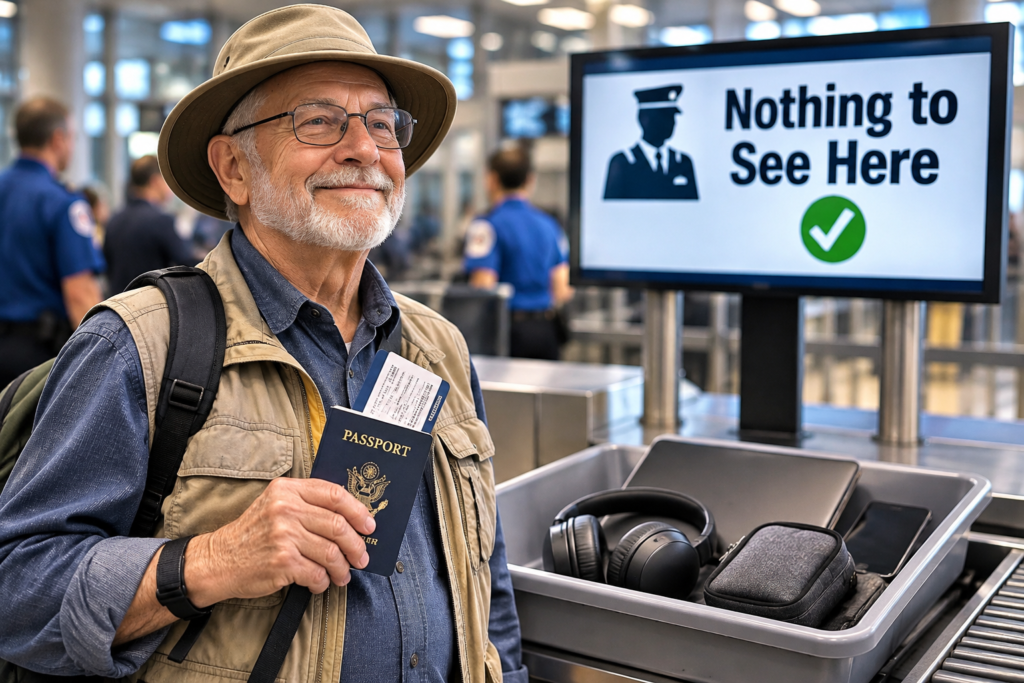
My goal is to be the most boring person in the airport.
Not boring as a traveler, of course. I’m planning to visit some of the most fascinating places on Earth. But when I encounter a border official, I want to be just another ordinary tourist. Nothing unusual, nothing suspicious, nothing to attract attention.
I carry ordinary electronics, luggage, and travel documents. My medications are in their original prescription bottles. I don’t employ exotic security equipment or carry unnecessary personal data.
I want to be an interesting person, not a person of interest.
That’s the guiding principle behind my approach to travel security. But it has grown into something much broader: a philosophy for managing the risks of a complicated journey.
Something Will Go Wrong
Nine countries. Forty-eight days. One trip around the world. Writing systems ranging from Cyrillic to Ethiopic to Devanagari.
Different currencies, laws, and customs. Every border crossing, flight, train, and hotel introduces yet another opportunity for something to go wrong.
On an ordinary vacation, a missed connection might cost an afternoon. On a journey like this, one small problem could disrupt plans thousands of miles and several countries away.
I assume something will go wrong. That’s part of traveling.
I can’t prevent every problem, but I can make sure that most problems are inconveniences rather than disasters.
The secret is having a Plan B. And a Plan C.
What If Technology Fails Me?
My smartphone has become my most important travel companion. It contains maps, translations, reservations, boarding passes, contacts, and access to many of the services I use while traveling.
Need directions? Google Maps. Don’t speak the language? Google Translate. Need a taxi? There’s an app for that.
All very convenient—until the phone disappears or the internet stops working.
I’ll use an international data-only eSIM to provide connectivity across much of the journey. But I don’t want to depend on an internet connection to find my hotel.
Before entering each country, I download maps and translation languages for offline use. Important documents are backed up, with critical information also available on paper.
I maintain a separate travel account containing the information I need for the journey, without exposing most of my everyday personal information.
If my phone disappears, my backup plan is to buy another, restore access to my travel accounts, and continue.
If the internet disappears, I can still navigate and find my way to the next destination.
Ideally, I should spend more time looking at ancient ruins than looking at my phone.
What If My Wallet Disappears?
Money presents another interesting problem.
In some places, credit cards are expected almost everywhere. In others, cash remains essential.
A perfectly good credit card can suddenly become a useless piece of plastic because my bank apparently doesn’t believe anyone would voluntarily go to Kazakhstan.
My solution is redundancy.
If one card fails, I have alternatives. And if a pickpocket decides my wallet would look better in his pocket, I haven’t lost every means of paying for a hotel or a meal.
I carry multiple ways to access money, including credit cards, debit cards, and cash. They’re not all kept in the same place.
One lost card or one uncooperative ATM shouldn’t bring the journey to a halt.
What If My Luggage Disappears?
Airlines occasionally misplace luggage. Usually, it’s merely delayed, but sometimes a suitcase takes a vacation of its own.
I’ve taken several precautions to help reunite us.
Each bag has an external identification tag with my contact information inside, an internal copy of my itinerary showing where it should go, and a Samsung SmartTag announcing where it actually is—which isn’t necessarily where the airline thinks it is.
But locating a suitcase and having access to its contents are two different problems. I’ve spread essential items among my bags, so if one goes missing, I’ll still have enough to get by.
The objective isn’t to guarantee that my luggage will never get lost. It’s to make sure that losing it doesn’t ruin the trip.
With Luck, None of These Precautions Will Be Needed
My phone won’t disappear. My luggage will arrive. My credit cards will work. The internet will cooperate. And every border official will find me utterly uninteresting.
If all goes well, the hours spent preparing for possible problems will produce absolutely nothing worth writing about.
Instead, I’ll have stories about the Silk Road, ancient cities, human origins, and the extraordinary people I’ll meet along the way.
The best backup is the one I never need.